Unknown's avatar

About Alex Laverty

Recent graduate from USC's Master of Public Diplomacy and UCLA's Master of Africa Studies programs. My interests lie in understanding the interactions between digital ICTs & society. I try to make sense how are these interactions are changing democracy, diplomacy, and development.

Could Green Be the Color of the Future for Africa?

Special Report – Business of Green – Leading Africans to Responsible Recycling – NYTimes.com

This interesting article should be seen as the way forward to many African economies. I think its quite odd that African industry should be expected to develop in the same way as European and American industry came of age during the Industrial Revolution. African economics need to find areas of the market that North America and Europe have either no desire or no substantial lead in those sectors and to exploit it to their advantage.

I’m sure the image of using Africa as the dumping ground for computer and electronics parts is not one that African tourism industries want to promote. But what if Africa became the worldwide leader in recycling electronics? The continent would be able to carve out a niche in the global market that is in high demand. Obviously, countries like South Africa and Nigeria have a leg up on the competition due to their substantial infrastructure, and they should put the pedal down and encourage more high potential growth industries to establish hubs in their country. Again the image of black Africans managing and working in a recycling plant that takes the West’s junk and turns it back around and ships it back might not be an image that is welcome. But it would provide jobs, would provide a endless stream of products, and has a solid long-term future. Can anyone imagine a world without electronics, or their rubbish? Someone will have to be willing to collect and destroy or recycle the parts, why not Africa?

The way out of poverty for the continent is each country to exploit markets that are currently considered small, but necessary. Matthew McConaughey’s movie Sahara, where the villans are running a disposal plant in Mali that can vaporize toxic/nuclear waste by harnessing solar power immediately springs to mind. The problem in the movie is that while storing the toxins as they wait for disposal there has been leakage into the underground water system. But the concept of a waste disposal system is ingenious. And while no one might necessarily set out to tell all the toxic waste producers in the world to ship them their barrels of sludge, think about how profitable a recycling/disposal plant like that would be. Factor in the shipping costs, the taxes payed on the profits, the high-tech/green jobs that would be created and you would have an industry that could be highly profitable for the private corporation and the country. Granted the investment in such technology would not be local, and the highly trained scientists might not be originally local, but that shouldn’t be a reason for dismissing the concept. Importing overseas talent would be a temporary measure as the nation’s government can then make an investment (through the tax proceeds of the new industry) in their country’s technical institutions to produce the scientists and technical hands to replace the expatriates that start out working at the plant. 

Thomas Friedman is one of the loudest voices pushing for a green revolution, and if he is to be believed ‘green’ industry is the next big thing. Hydroelectric power from the Congo, solar power from the Sahara, recycling plants in South Africa could be all part of an industry that could be led by those on the African continent. Creating that monopoly on green industry could inspire a new century of growth that would see the continent become an equal of the industrial north. The symbiotic relationship that could be created would be sustainable for both north and south economies, and just as important, for the planet.

High level of AIDS myth in Recent Study Caused by Zuma – Zille

Zille blames Zuma for Aids myth – Mail & Guardian Online: The smart news source.

Not quite sure why this lady is continueing to attack Zuma and the ANC. She brought the full brunt of the ANC and ANCYL on her when she said he put his wives at risk for HIV/AIDS (which no one seemed to think is a given seeing as he has had sex with an HIV+ women and presumably continues to have sex with his wives), but now Zille is using a new study by the University of Stellenbosch that 27% of those youth survey believed  “they could prevent HIV infection if they bathed after sex”. 

I have to admit that during my time in South Africa, I would never have guessed that 1 in 4 youths believed such a myth. Perhaps it was because I was in a university setting that filtered out some beliefs, but this has to be a shocking finding to those in the Health Industry and HIV/AIDS groups. 

This Zuma-slant seems to be a reoccurring problem with the DA’s tactics at the moment. They start fights and say things in interviews that they know will get the ANC’s attention and cause a backlash. This carries over from the campaign of ‘Stop Zuma’. The DA needs to quickly get over that mindset and start to function as a proper opposition or they’ll soon alienate all those people they seek to win votes from.

Instead of going after Zuma over the wives stuff, the DA should be showing that the example that Zuma sets on HIV/AIDS does indeed filter down to the young people of the country. But now the debate is going to be construed in a Zille-Zuma fight and not about the real issue of education people on protection from HIV/AIDS. This also has to surprise people who believed that since the era of AIDS denialism in South Africa that significant progress had been made. The study shows that much more is needed in terms of broad public education, as people in university would see AIDS myths exposed, students that are not fortunate enough to get into that academic setting must be targeted by the education campaigns.

NYT Travels to Malawi in Unnecessary Class?

When I saw this article in the New York Times, I was excited to see if the author had gone to a different part of Malawi than I and what he found there. As I began to read the article and realize that he followed the journey that I took, it became interesting to compare the relative experiences in terms of funding and perceptions of the country. 

There is nothing terribly wrong with the piece, just that it is portraying a view of the Malawi experience that was unobtainable with the budget I had going through Malawi. Thus it is interesting to read how those with a larger budget were able to see the country. What I learned however, is that despite his substantially larger budget, he saw many of the same sites and scenes of Malawi as I did, and came away with the same satisfaction of his trip, if only at a much higher cost.

However, his advice to that it is adviseable to hire a driver for your time in Malawi is completely unnecessary. While, danger on the roads, especially in Blantyre is significant, it is no more than any other major city.
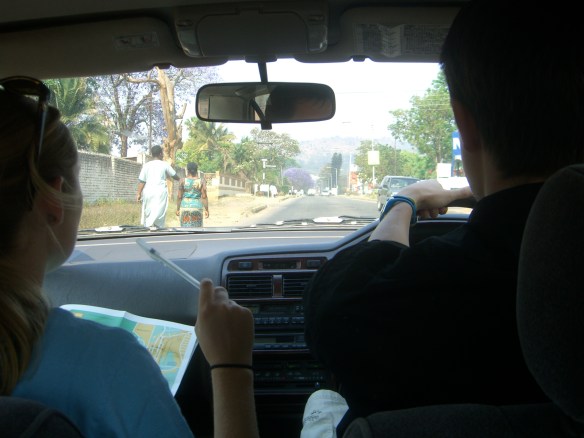
Driving out of Blantyre

Driving out of Blantyre

Plus, once out of the city the rarity of finding another driver on the same road is low enough that you would not need to worry about accidents on the motorways. One caveat to that is, that if you are hesitant about passing on the right-hand side (Malawi, like most of Southern Africa is a left-hand drive country), then you’ll have an even more exciting adventure. Though I must reccomend that the driver should place a male in the front seat on the left hand side. Women who may not realize that the road is smaller than two lanes may constantly point out that the space between them and the truck that you are trying to pass may be slowly (or quickly) decreasing much to their concern. The way they present their concerns can unnerve the driver to a certain extent. 

Second, the roads going north to Liwonde and Lake Malawi are not in a condition to allow for a high rate of speed. They are littered with large potholes that can require the driver to do some defensive driving in order to navigate the maze that they create without having to slow down to a snails pace. There were stretches on the road north that were unpaved, but most of it seemed to be due to pending road work, and could easily be passed through by a 2-wheel sedan. However, these certainly do not require any special training or the expense of hiring a driver to do the fun part for you.

We used a Toyota Corona, that was rented from a hole in the wall rental company. We had originally selected SS-Rent a Car for a 4-wheel Toyota 4WD vehicle, because it was a significantly cheaper rate than we normally payed in South Africa. However, on arrival, and seeing that it was a manual drive car, which meant that none of the girls in my group could drive in case of an emergency, plus the fact that it was a diesel fuel vehicle made us recalculate and eventually decide to look some place else. This search led to an entirely new adventure as we had planned to jump in the car on our first full day in Malawi and head to Mt Mulanje to hike its trails. We proceeded into town once again to look for the AVIS location, only to learn they had moved out to the airport, which required a combi ride out of the city. On arrival we spoke to the AVIS rep at the desk and told him what we were looking for. He said he knew of a person who could help us, and had cheaper rates. We thought this odd, as the rates were printed right on the desk, and we knew there were no other car rental companies in Blantyre. Eventually we’re driven down the road to a house off the main road where we go and learn that this is not AVIS but that we’ve been passed on to an entirely different company, by an AVIS employee. This worked out, as the rates were in fact cheaper (though all in cash) and the man who worked through it with us was very kind and helpful in getting us on our way. Though we did not make it to Mt Mulanje, the experience of simply finding a car to rent more than made up for it.

Like the author, we also stopped at Liwonde National Park for two days, where we had the most enjoyable experience at a game park in our entire time in Africa. The park is not nearly as commercialized/toursity as the South African private game reserves. Like the author writes, it is much in the vein of game reserves of the past century. We certainly took that to a new level as we chose the lesser expensive, and less famous Chinguini Hills Camp (they were excited as the year we were there they had pipped Mvuu for top spot in the Lonely Planet guide book for places to stay in Liwonde, we would certainly concur). Par his trip, the NYT author stayed at the luxurious Mvuu lodge, which is far and above our budget as students. Our accommodations were quite spartan but the home cooked meals and the tours that were provided by the staff were excellent. Though I must advice against a night safari, as ours turned up little of note for the cost of 15 dollars and a sore back from the bumps of the humvee (though it looks as if there rates have increased since we were there). The early morning trek was the most profitable in terms of animals as we were able to stand no more than 20 feet away from water buffalo, who were as interested in us as we were in them. With the entire group staring and tracking us as we paced our way around the herd, it certainly made us feel that they were only permitting us to roam only as long as we kept silent.
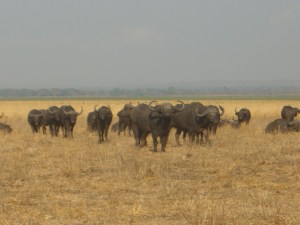
Waterbuffalo at Lake Liwonde

Waterbuffalo at Lake Liwonde

 Later we were able to watch a group of four elephants make their way to the lake from a distance of about 1000 meters. While getting close enough to touch Elephants while on safari is easy enough in game parks in South Africa, when on foot, the experience is quite different, and 1000 meters is as close as one wants to get. 

Finally, he reaches Lake Malawi at Cape Maclear. Again, he stays at the fancy Sunbird Lodge, where we stayed at the Gaia House, which was a friendly place on the beach, that had a nice courtyard and clean facilities. The reception for a mobile signal was terribly poor for one person in our party who required contact with the boyfriend stateside, but the experience was very relaxing. The food was also of very high quality at the Gaia House, though terribly slow, so anticipate your hunger before it hits or the wait can be difficult.
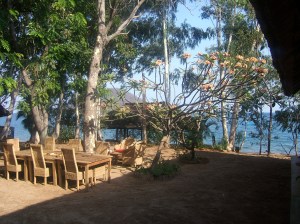
Gaia House at Cape Maclear

Gaia House at Cape Maclear

However, they more than make up with their portions and the taste must to our delight. We also enjoyed lunch and dinners at various restaurants up and down the beach, where the the Gecko Lounge was one of our favorites. Also, the only place on the beach for Champions League or Premiership matches as they had the bar with a Supersport subscription on the beach at the time we were there (September 2007). 


The author fails to warn travelers of the hawkers at Cape Maclear. Though I have much experience in saying ‘no’, and spotting them along the road or in town, we fell for one on our way into the village. At a fork in the road we stopped to look at the road sign that pointed to each lodge and which fork to take. At this point, conveniently, there were men on bicycles standing at the fork. One asked us where we were going, and he proceeded to lead us to the lodge, without any prompting. However, we understood the deal and were prepared to pay him for his services when we arrived. However, he suspscious disappeared as soon as we parked. We assumed that we might have misjudged his intentions and he was simply helping us out. However, he returned that evening on the edge of the lodge’s property (we quickly realized that he must have a reputation and was not welcome on the lodge’s property which was the reason for his disappearance on our arrival). He showed us pictures of ‘his’ boat and a bunch of white Europeans going out on ‘his’ boat and enjoying ‘his’ tours and ‘his’ braai. The pictures looked terribly inguinine, especially since he was in none, and they looked like they were pictures of people in the early 1990s. We politely said, we’ll think about it, but that we had already made dinner reservations for our first night. He of course wanted money up front in order to go collect food and provisions for our ‘beach braai’. We had read about these people before our trip to Malawi and were told to be weary as many children simply took the money and then never showed up that night to take you to ‘your party’. Others have written that they can be quite enjoyable, but either way we had no money with which to take the chance, nor did we want to be dragged someplace on the beach at night before we had a chance to walk around ourselves. While I was out, he came back that night and verbally argued with my friend who had stayed behind and told her that we ‘owed’ him and that we were supposed to accept his invitation because he led us into town. My travel-companion politely worked her way out of the situation and ‘tipped’ him for the service he provided early in the day and sent him on his way. 

All total, our trip per person (for a group of four) cost around USD 800 in 2007. This included transport from Durban, South Africa via overground bus to Blantyre, plus car rental for 5 days, plus all the food and accommodation along the way. Which can show that the $6,200 trip that is proposed in the NYT article seems to be inflated to such a degree that one must wonder where all of that profit really ends up. When you consider that one room at the Sunbird Lodge costs $121, and a bed at Gaia house is $5, the savings can add up substantially. Though the NYT is certainly catering to a class of traveler well above a student’s budget, in all my travels through Africa I have seen that paying for that Western-high class facility is never worth the cost, especially when you could convert that savings into going further and doing more on your African adventure.
Another Call for Assistance for Zimbabwe

If one was to look back through the Archives of this blog, one would find a post where one of the authors of this blog promised a step by step plan for how to help Zimbabwe, instead of the typically useless ‘calls for solidarity’. As the formation of this plan went along, holes began to develop and the whole idea became vastly more complicated and detailed than was originally set out to be. The African File’s now defunct sister site, The Fertile Cresent File, tore into the drafts of this project, and as time went along the situation on the ground continued to change right up to the unity government that was forced upon the MDC and Mugabe by SADC. Since then the world has watched (though less so than in 2008) as the two rivals parties try to form something resembling a functioning government. I had given up on any prescription because the situation seemed to deal more with personalities and certainly a little bit of luck, rather than any post-conflict organizational chart.

Since then, we have had a MDC Minister arrested, Morgan Tsvangirai’s wife has been killed in a traffic accident, and Mugabe has celebrated his 85th birthday.

All of which leads to this article from the Huffington Post by two ICG writers:

International Crisis Group – Sydney Masamvu and Donald Steinberg in The Huffington Post.

I have a few issues with this piece, other than the repeated calls for aid.

First deals with this paragraph:

…failure would likely lead to a new seizure of power by Mugabe and his hardline allies, even greater repression and isolation, and new hardship and abuse for the long-suffering Zimbabwean people.

I think this does quite an unjustice to Mugabe. I mean, it would be awfully hard to top the repression and isolation that has gone on in the country. I would be curious to learn where there were any areas in the lives of ordinary Zimbabweans that wasn’t ‘hard’ already. To suggest that it could be worse, is to suggest that Mugabe hasn’t been at the top of his game. I wonder how he’ll respond to that criticism. 

Second, is the impression that the regional body SADC actually gives a damn about Zimbabwe through the channeling of funds:

The regional grouping of the Southern African Development Corporation (SADC), has recognized the stakes, and is putting its money where its interests are, including through new financial support from South Africa and Botswana. It is time for the broader international community to do the same.

Masamvu and Steinberg realize that these are the only countries that would even have money to contribute, yes? Angola is spending their saved up petro dollars on football stadiums for the next ACN. Mozambique is just getting its budget together after years of actually useful help from the IMF/WB. Zambia is getting poached by vulture funds. Namibia is dealing with water shortages and aid reductions. The DRC is the DRC. Madagascar is suspended, Tanzania has never made a meaningful contribution to regional development lately, and everyone else is too small to have any kind of political or economic impact. Thus to back up a claim that SADC is actually interested in solving Zimbabwe’s crisis by funding through Botswana and South Africa (who are coincidently asking us to help pay), does not really make much sense. On top of that, they include a quote by Tsvangirai saying “Don’t make us pay for working with Mugabe.” They fail to read between the lines of this quote, because what Tsvangirai really means to say is “Don’t make us pay for working with Mugabe….because you made us do it“. SADC thought they had performed their role by holding the firearm in this shot-gun marriage. With their hands now washed of Zimbabwe, they can now blame the MDC and maybe ZANU-PF if and when they screw up.

Finally, to suggest that it is the US/UK refusals to contribute humanitarian assistance as the reason for service failure in Zimbabwe is overstating the effect of Western aid. Nothing short of an invasion by medical personnel, engineers, and teachers would help begin to tackle the challenges faced by the country. To suggest that simply freeing money to support these ventures would cause anything more than a bump in PR rating for the West buys into the antiquated belief that aid can have profound effects on a country simply by giving more and more. Many books have recently been published that should diminish this belief that aid can achieve anything when funneled through sovereign service delivery agencies or that half-ass projects by the UN or the West will cause significant societal changes. People would certainly argue that something is better than nothing, but I would argue quite the opposite. Either invade Zimbabwe with services and personnel, say to the unity government “take seat, you can come back in 10 years” and then commit to a decade long project of education and service improvements, while letting the politicians map out a long-term plan of reconciliation and civic society building, OR let the Zimbabweans figure it out on their own. Anything in the middle will just prolong the final product of a safe and prosperous Zimbabwe.