Cote d’Ivoire and Post-Conflict Branding
By Alex Laverty
A country that is emerging from a violent internal conflict often has a significant amount of rebuilding to undertake. This usually includes the service delivery sector, the import and exports markets, and the ways that citizens interact with politicians. A glaring issue that is often not treated at the same level as security or domestic services is the international image of the country, which has been negatively affected by the conflict. While there are rare cases when conflict elevates a country’s brand or soft power, most internal violence often bares cleavages in that society to the entire world. When outside intervention is required it signals to the world community that the society is incapable of solving their own disagreements, thus further deteriorating whatever good standing the country had in the eyes of the world previously. However, as it is nearly impossible for a country brand to change radically, there remain sources and images of brand resources that can help the country post-conflict. Often these images are obscured by the fighting and the social and economic toll of destruction. Thus post-conflict, there needs to be concentrated efforts to either reintroduce or reemphasize the representations of the best of that society. By doing so, economic and social recovery can be hastened by the benefits of increased country brand awareness.
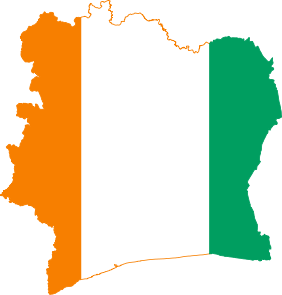
In Cote d’Ivoire, a rebuilding is underway after the Second Ivorian Civil War. The conflict involved the French military and the United Nations and resulted in the forceful removal of one leader and the installation of the internationally recognized winner of the 2010 elections, Alassane Ouattara. Claims that human rights violations were committed by both Ivorian sides were leveled during and after the conflict. Due to the nature of the division of the country, along north-south divisions as well debates on citizenship validity, the reconstruction and reconciliation processes will be difficult. Overcoming these negative images from the conflict, along with the more ingrained disposition that French colonialism has placed Cote d’Ivoire in, will need to be addressed when building a new brand for the country.
Issues from Colonialism
Cote d’Ivoire faces a global recognition problem not just due to its recent history but also with its brand following independence. This is similar to other African states who face difficulties in standing out in a crowd of 53 nations. However, specific to Cote d’Ivoire is the issue surrounding how other countries and their media outlets discuss the country.
Since 1985 the country has asked that it be referred to as Cote d’Ivoire in all language registries. While FIFA, the IOC, and The Economist refer to the French name when referencing the nation, nearly all other major media outlets (BBC, South African Broadcasting Company, The New York Times, and The Guardian) all continue to refer to the country as ‘Ivory Coast’. Due to this confusion around the name of the country, Cote d’Ivoire faces a branding issue faced by few other nations in the world. While the economic linkages due to France means this is a non-issue in many circumstances, if the country hopes to break its reliance on France, it will need to solidify its name internationally.
Issues from the Conflict
The Ivorian brand has suffered for over a decade since the beginning of a anti-government rebellion in 2002. Since then, the country has been the focus of negotiations and stalled election dates. The focus of international attention brought about by the fighting between the two groups of presidential supporters and the intervention of the French military will undoubtedly play into the negative stereotypes held by developed nations about West African states. The fact that Cote d’Ivoire was the region’s power house 30 years ago has likely faded from any institutional or personal memory. Regionally, the long stand off between the government and the rebels will cause significant harm to its reputation because it was a constant reminder to the citizens of the region that Ivorians were split in two for a decade. However, more important for regional rehabilitation will be the xenophobic rhetoric that fueled the conflict.
While this talk of a ‘true’ Ivorian was first used in 1995 to block the current President from running, it has become part of the political lexicon of the country to discuss whether one is truly a citizen if their parents were born in neighboring countries.
With the country reliant on foreign labor for agricultural production, the damage to the country’s image as a attractor of labor may suffer in the short to medium term. With Ouattara (with foreign-born parents) winning the Presidency it will be his responsibility to maintain and strengthen the ties he made with regional leaders during the stand off and to make sure that Cote d’Ivoire’s neighbors do not see them as xenophobic society. A country brand that is tagged as xenophobic with an economy reliant on foreign labor is a dangerous combination.
Building a New Nation Brand
To address the naming surround the country, I would advise a straightforward effort to increase awareness of the French spelling as well as aiding the economic recovery. First, I would utilize the fact that the country is the largest producer of the world’s finest delicacy. 30% of the world’s chocolate (cocoa) comes from the country. As the largest supplier of the bean, the country has an opportunity to use the near universal awareness of the product as way to build the country brand.
While the country has been in the spotlight for using slave labor to harvest the bean, the recent electoral violence has no doubt replaced that fact in the world’s consciousness. Thus, to capitalize on their market dominance, the new Ivorian government should invest in manufacturing plants in the country in order to export finished products of cocoa based commodities, rather than raw materials. While this has been an economic incentive in other African countries that produce raw materials such as oil, the branding potential is much higher for chocolate because it is not associated with resource or inter-state violence like petroleum is often connected to. Exporting finished products that bear the branding “Grown and made in Cote d’Ivoire” serves two purposes. It helps show that the French-spelling is used even in the English marketing, plus it can help bring widespread (positive) awareness to the country for the production of a premium product that is not associated with violence or civil conflict.
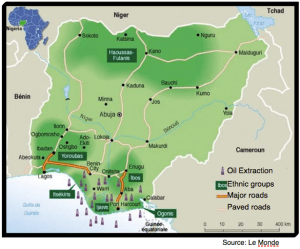 When colonialism ended, the founding fathers of African independence made a critical decision in state formation. They accepted the borders drawn up in Europe as the sovereign domains of the newly liberated African states. However, these lines were often arbitrary, and neglected ethnic and geographic considerations. The colonial state imposed these borders through the agreement drawn up at the Berlin Conference in 1884, and enforced control through repression and manipulation.The post-colonial state lacked the resources, the skills, and often the legitimacy to simply subsume the capacity of the colonial administration. Thus, groups were able to exist outside of the purview of the central government or in prominent opposition to the state.Over the past 20 years, as commodities have become a larger part of African countries’ GDP, the benefits of controlling the state have risen considerably. Thus the economic differences between those in favor by the central administration or those marginalized have increased substantially.Without the same economic incentives, violent pressures, and geographic partitioning that characterized state and nation formation in other parts of the world, African states remain colonial amalgamations. To overcome those origins, there needs to be stimuli introduced to inspire greater cohesion among the populace, in a way that will encourage and incentivize the citizens of these states to pool their combined resources, rather than seeking to divide themselves along older ethnic or tribal boundaries.To create this incentive, the Nigerian government should work towards immediately engaging in constructive talks with Boko Haram in order to grant them some level of self-governance and to negotiate a level of autonomy. This would be a radical break from previous government interaction with non-state armed groups and seemingly counter-intuitive in terms of nation-building. However, despite military campaigns to crush radical opposition groups around the world, the underlying causes of the anti-government sentiments have not been solved. Poverty, political corruption, economic marginalization, and the lack of investment are well known to be root causes of insurgencies, radical movements, and jihadist groups. Military defeat will not create greater national harmony, in fact it will create the opposite.
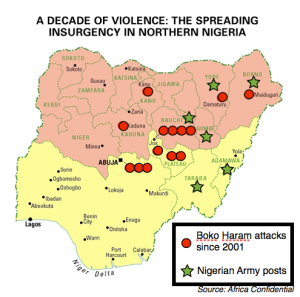 In this scenario, Nigerian public diplomacy can begin to engage the people of this autonomous region to reinforce how unity under the state, while far from perfect and in need of much reform, is a better option to the fractious alternative that they chose. Already, the northern region of 60 million people rely on government funds to prop up their economy as their previous enterprises have faired badly in the face of Chinese competition or dwindled through agricultural decay. The Nigerian government will need to back up this outreach through quality and lasting reforms. Education should be the forefront of any engagement with the north as the benefits from increased schooling and skills can directly dispute the content of Boko Haram’s message that western education is a negative influence.
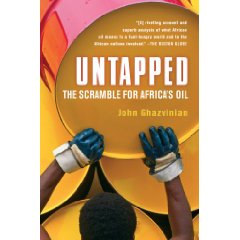 exploring and investigating the current and future oil producers of the continent and provides a comprehensive overview on the potential for success or failure facing African petrostates. Reading as part – travel journal, part – socio/economic/political analysis, Ghazvinian has provided the ideal book for anyone wishing to understand the history and current happenings of the African states of Nigeria, Chad, Sudan, The Congo, Gabon, Sao Tome and Principe, Angola, and Equatorial Guinea. His insightful investigating shows how he talked with just about anyone and everyone that was impacted by oil in Africa. From the Oil Execs at the super majors (ExxonMobil, Shell, BP, etc) to the politicians, to the rural villagers adversely affected by the drilling, everyone has the voice heard in Untapped.
  The African File