Robert Mugabe, Zimbabwe’s underfire president, has decided that the past year of rigging elections, murdering opposition supporters, and being staunchly against sharing his power, has taken a toll on his nearly 85 year old body and is going to take a one month vacation according to the Mail & Guardian. One must ask where one would go in Zimbabwe to vacation these days, much less the all-a-round hated leader of the imploding nation. One would hope that he might head to Victoria Falls where we could all pray that the Zambezi might sweep him over the edge, but alas, he’s decided to take what must be the last bit of foreign currency reserves the government holds and use them to vacation abroad. Says his spokesman George Charamba:
This is more of a retreat than an annual leave. The president is very busy reflecting on the new structures that are needed to deal with the economic sanctions against Zimbabwe as well as working on structures of an inclusive government which must come too soon
These are the times when you wish that ZANU-PF was facing anything but a subjugated press, or at least a media outlet that would ask, “So how far off is ‘too soon’?”
A deeper analysis could reveal two things. One, Mugabe is so secure in his power of controlling power that he knows that whether he is in the country or not, he is able to maintain his iron grip. Two, he knows a coup is coming, and does not want to be caught in the cross fire and is using this ‘retreat’ as a way of getting out of the line of fire and thus living out his days in exile. Or, a more likely third probablity, Mugabe has long been oustered from the real center of power in the party and in the country, and thus is just being used as a figure head for ZANU-PF. The people really in charge of the suppression of opposition and of land redistribution have slowly wrestled power away from Mugabe, though in his old-age they probably still convince him that he makes all the ‘real’ decisions.
Whatever the deeper meaning or reason behind his vacation, this would be the perfect time for outside intervention from the AU or the UN, but that’s more of a fantasy than Mugabe falling off Victoria Falls…
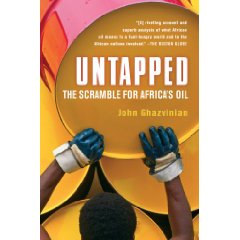 exploring and investigating the current and future oil producers of the continent and provides a comprehensive overview on the potential for success or failure facing African petrostates. Reading as part – travel journal, part – socio/economic/political analysis, Ghazvinian has provided the ideal book for anyone wishing to understand the history and current happenings of the African states of Nigeria, Chad, Sudan, The Congo, Gabon, Sao Tome and Principe, Angola, and Equatorial Guinea. His insightful investigating shows how he talked with just about anyone and everyone that was impacted by oil in Africa. From the Oil Execs at the super majors (ExxonMobil, Shell, BP, etc) to the politicians, to the rural villagers adversely affected by the drilling, everyone has the voice heard in Untapped.
  The African File