South African President to Dissolve Parliament? Call New Elections?

A report by Stratfor, tucked away nicely on their members-only page, is titled South Africa: President To Dissolve Parliament – Report. Such a course of action would seem prudent if viewed from a political perspective. While this year’s regulary schedule general election were to be held sometime between April and June, this recent possible action by South African president, Kgalema Motlanthe, could signal the African National Congress’s (ANC) growing concern over the upstart breakaway party, the Congress of the People (COPE). 

ANC may well claim that since the dismissal of Thabo Mbeki from head of state, Motlanthe has been in a care-taking role and that with the current worldwide finicial crisis, it is more appropriate to get a new government seated sooner, rather than later. Motlanthe has certainly kept the ball rolling on certain ANC projects, one of which was the dismantling of the Scorpions, but he has not undertaken any other major endevors as he has no political capital of his own. The looming shadow of Jacob Zuma must also be inhibiting Motlanthe during his Presidency. (To See a Review of his first 100 Days in office, see his interview with the M&G) This claim that a legitimate government is needed to handle the financial crisis would seem to make good sense, as a new government would be able to react to the crisis and use their newly earned political capital to implement their plans.

Oddly enough, another possible reason for the early election might be a new possibility for South Africans abroad to vote overseas. While not all inclusive, the government may want to speed up an election, so that word of mouth of the new provision has not spread sufficiently in time for an overseas vote to be significant. As most of the overseas vote would most likely favor the DA or possibly COPE, the ANC is not exactly advertising this new ability to vote abroad.  

The ANC must also be worrying about any growing influence that COPE is gathering in former ANC territory. It would be rational to believe that the longer COPE has to prepare for the elections and to publicize their platform, the more successive they will be in the election. Whether this plays out in this fashion is still to be seen, but its a fair bet that the 2009 South African election may well be the most exciting since 1994. The smaller parties are sensing the division in the ANC may mean more votes for their platforms, but I believe the actual number of electorate defections will be less than is hyped in the media. In any case, voter participation may rise for the first time in South Africa’s post-apartheid era.

Which ever reason is given by President Motlanthe to call for elections before the normal timetable, there must be a period of 60-65 days between when an election is called and when the actual voting day is established. COPE has claimed that a date of March 25th has been set, denied by Motlanthe, but in reality will one or two months make a difference to COPE’s success at the voting booth? They might argue yes, but in reality I believe that those who were ready to cast a non-ANC vote have already made up their mind about COPE. Those rural people who COPE may try to target for conversion from ANC stalwarts cannot be converted in months, rather years.

While 2009 sees the first formidable splinter group of the ANC pose a challenge to the ANC, no real power change will happen this year. It may be 2014, or beyond, before a COPE, or a COPE-DA alliance, could seriously threaten the stranglehold the ANC possesses over the South African electorate.
Calls for Action in Zimbabwe – Will Anyone Actually Give a Realistic Plan of Action?

Today’s Washington Post Opinion page featured a piece appropriately named as it was penned by two physicians, In Zimbabwe, a Cancer Called Mugabe, which like many governments and other advocay groups called on the help to be made available to Zimbabweans. Unfortunately, they don’t go into spcifics about what kind of ‘help’ should be given other than that under the wide ‘humanitarian’ banner, nor do they even give any guidance to Barack Obama for what he should actually DO.

This seems to be the theme of most op-ed articles, opinion pieces, and major world instituions who have been calling for ‘change’. Everyone seems to agree that Mugabe must step down (1, 2, 3), but since Mugabe could obviously care little for world sanctions or condemnations (much less any empathy for the citizens of his country), how do these writes and politicians actually envision Mugabe being removed from power? Certainly no military action is considered by Western nations, and it is even more ridiculous to assume it will come from any African Union member at this point. Freezing of his monetary resources, along with the rest of his ‘cronies’ seems to have done little to result in change.

The world does not seem to recognize that they are dealing with a stubborn, old, and proud African man. Do leaders and journalists think that simply writing about his rule and his iron-fisted ways will bring about real change to the regime? If they do not, then why bring any attention to the situation at all? Is it a good topic to fill up the the ‘holier than thou’ part of the newspaper? Saying, look at us, we’re looking out for our fellow citizens of the world by writing about their blights, but don’t ask us to actually implement, much less create a feasible plan of action. 

The Zimbabwean currency lost is value some time ago (I actually have Zim dollars that are expired), the opposition party is being ruthlessly beaten and jailed by the ruling party seemingly attempting a MLK-approach to Mugabe’s rule, and citizens of the neighboring countries have called on their governments to act, but have seen only half-hearted plans for a unitary government, a sole organizer for regional meetings on the topics and rebukes of ZANU-PF from no one of note other Botswana.

Though calls for Mugabe to step down have grown steadily from African leaders, no one seems to ever say ‘or else’. They all call on him to end the suffering of his people. HIS people? Does any one think that Mugabe actually sympathizes with the rural people of Zimbabwe? He cares about keeping his inner cirlce happy, and he has done that to such a degree that all he has to do is set them loose on the farms, and they’re perfectly content with his rule.

How does change come to Zimbabwe, real change, real development, and the return of simple government services? Next week, The African File will present a 5-piece plan of action to bring about actual change, that will not just yell ‘do something’, but will say ‘do this‘.

Proof that Even A Dictator Can Tire From Destroying their Country

Robert Mugabe, Zimbabwe’s underfire president, has decided that the past year of rigging elections, murdering opposition supporters, and being staunchly against sharing his power, has taken a toll on his nearly 85 year old body and is going to take a one month vacation according to the Mail & Guardian. One must ask where one  would go in Zimbabwe to vacation these days, much less the all-a-round hated leader of the imploding nation. One would hope that he might head to Victoria Falls where we could all pray that the Zambezi might sweep him over the edge, but alas, he’s decided to take what must be the last bit of foreign currency reserves the government holds and use them to vacation abroad. Says his spokesman George Charamba: 

This is more of a retreat than an annual leave. The president is very busy reflecting on the new structures that are needed to deal with the economic sanctions against Zimbabwe as well as working on structures of an inclusive government which must come too soon

These are the times when you wish that ZANU-PF was facing anything but a subjugated press, or at least a media outlet that would ask, “So how far off is ‘too soon’?”

A deeper analysis could reveal two things. One, Mugabe is so secure in his power of controlling power that he knows that whether he is in the country or not, he is able to maintain his iron grip. Two, he knows a coup is coming, and does not want to be caught in the cross fire and is using this ‘retreat’ as a way of getting out of the line of fire and thus living out his days in exile. Or, a more likely third probablity, Mugabe has long been oustered from the real center of power in the party and in the country, and thus is just being used as a figure head for ZANU-PF. The people really in charge of the suppression of opposition and of land redistribution have slowly wrestled power away from Mugabe, though in his old-age they probably still convince him that he makes all the ‘real’ decisions.

Whatever the deeper meaning or reason behind his vacation, this would be the perfect time for outside intervention from the AU or the UN, but that’s more of a fantasy than Mugabe falling off Victoria Falls…

Untapped – The Scramble for Africa’s Oil

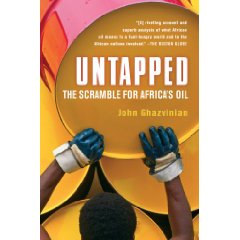
Untapped, written by John Ghazvinian, was an excellent introduction to what the author refers to as the ‘Second Scramble for Africa’. Ghazvinian jaunts about AfricaUntapped exploring and investigating the current and future oil producers of the continent and provides a comprehensive overview on the potential for success or failure facing African petrostates. Reading as part – travel journal, part – socio/economic/political analysis, Ghazvinian has provided the ideal book for anyone wishing to understand the history and current happenings of the African states of Nigeria, Chad, Sudan, The Congo, Gabon, Sao Tome and Principe, Angola, and Equatorial Guinea. His insightful investigating shows how he talked with just about anyone and everyone that was impacted by oil in Africa. From the Oil Execs at the super majors (ExxonMobil, Shell, BP, etc) to the politicians, to the rural villagers adversely affected by the drilling, everyone has the voice heard in Untapped

Before reading Untapped, I knew how oil was impacting the outlook of the continent, but never heard the details of the dealings between the supermajors in the oil business and how they dealt with national governments and their populations. These revealing stories that Ghazvinian tells in his book should be of particular interest to those who wish to see how oil is interacting with the national politics of many African nations.

The book is a must read for anyone interested in the continent of the Oil Producing business, but is critical for anyone researching potential national security concerns for those countries of the West. As Ghazvinian shows in  the book, the cheque book of the Chinese could replace some of the stalwarts in international finance such as the IMF and the World Bank when it comes to dealing with aid in Africa. For so long the International Monetary Fund and the World Bank have attached strict conditions to any aid or loans received by African governments from these two institutions. With the Chinese government willing to attach significant aid packages, without any preconditions or stipulations, to their bids on oil blocks, the dynamics in Africa could change significantly for the worse. Or rather more frightening may remain just as corrupt as they currently stand. However, another perspective could be put forth that less outside interference from Monetary Institutions and Foreign governments could lead to a greater degree of sovereignty for these African petro-states. However, if they continue to degrade the democracy that exists, or block the voices and concerns of their own citizens, the world must be seriously concerned about the use of petrodollars to pad politicians’ bank accounts and the purchasing of military equipment.

Ghazavinian makes no subjective judgements on the African leaders and the actions of the Oil Companies, which makes the book such a strong review of the continent’s ‘black gold’. However, the overall tone that is found from the book says that if significant changes are not made by the way African petrostates spend and use their money from oil profits, the ‘Dutch Disease’ and ‘curse of oil’ will propagate throughout these oil producing states benefitting the wallets of the gas guzzling West and corrupt African politicians rather than any improvement in the lives of those Africans living on less than $1 a day.

Academic Resource:

Untapped has a solid index, from which to quickly surf the book’s contents, but what sets this book apart is the solid list of sources and further reading that Ghazvinian provides at the end. A map showing his visited countries is in the front of the book, which proves useful for those unfamiliar with the region, but no other media is presented. A quick read due to Ghzavinian’s writing style should make it very accessible for students needing to use it as a resource

Overall Rating: A