I’ve been brainstorming lately of a project for my thesis that would combine my interests in technology and politics on the African continent. With last semesters’ research into deregulation of African ICT, I want to focus on something more current. With the current events in North Africa being partially attributed to Twitter, Facebook, and the like, I want to see if Social Media and the ICT that powers it can have any discernible effects on other parts of the continent, specifically Sub-Saharan Africa, where there has been no spillover of the democratic movements. Thus with 17 presidential elections happening on the continent south of the Sahara this year in Benin, Cameroon, Cape Verde, Central African Republic, Chad, DRC, Djibouti, The Gambia, Liberia, Madagascar, Niger, Nigeria, São Tomé and Príncipe, Seychelles, Uganda, Zambia, and Zimbabwe there would seem to be a large sample size to gather data about ICT and Social Media’s impact on elections. But how to measure this impact? What indicators would I need for ICT and elections? Are these countries a large enough sample size, or should it be expanded to countries where ICT data is more readily available but are having only Parliamentary or Local elections? Or perhaps this should cover 2011 and 2012? With the massive growth of mobile phones on the continent, and more landings of fibre-optic broadband cables, using this connectivity for good governance could be a critical feature of studies on the continent in the coming years. Continue reading
Category Archives: Politics
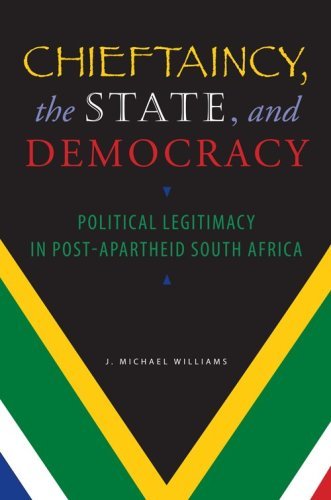
Review of Chieftaincy, the State, and Democracy: Political Legitimacy in Post-Apartheid South Africa
Click Here for: Outline for Book Critique
In J. Michael Williams’ Chieftaincy, the State, and Democracy: Political Legitimacy in Post-Apartheid South Africa, the relationship between the new South Africa’s sources of mixed authority is examined through field research conducted in rural areas in KwaZulu-Natal around the turn of the Millennium. Williams tells of an ongoing struggle in South Africa about political legitimacy between the state and chieftaincy regarding which institution has the right to exert authority in rural areas.
Williams focuses on how the chieftaincy seeks to establish and maintain its political legitimacy with the local population as well as the state in the post-apartheid era. Through comparative case studies he analyzes specifically on how chieftaincy and local populations have negotiated the introduction of specific norms, rules, processes, and institutions that are fundamental to the ANC’s policies of transformation and democratization.Through a framework that Williams calls the multiple legitimacy framework, he seeks to show how the chieftaincy has sought to establish and maintain its authority in the midst of these political changes. With chieftaincy still a central figure in the lives of rural communities in South Africa, the examination of the complexity of the chieftaincy-state and chieftaincy-society relationship that have formed and continue to evolve in the post-apartheid world.
Williams says his analysis is necessary because current assumptions about legitimacy conclude that power will eventually reside in the government as democracy and local government become more ingrained in society. He uses his framework in understanding the results from three case studies in the South African province of KwaZulu-Natal and supplements the data with national economic and survey data from other authors in the field. While stopping short of drawing empirical generalizations, he seeks to use his analysis to tell the story of real South Africans who deal with the struggles of the post-apartheid political structure in their daily lives.
The African File Makes Scholarly Contribution To Zimbabwe
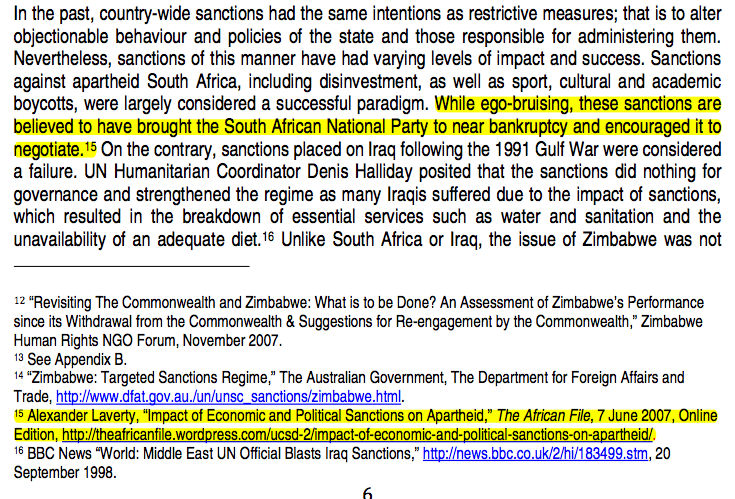
A recent search on the Google search engine has brought an exciting discovery to The African File. In a recent report by IDASA, the Insititute for Democracy in Africa, their work noted The African File’s Impact of Economic and Political Sanctions on Apartheid as a source in the footer. Despite the 4300 hits that article has received in just over two years, this is the first time it has been mentioned in a scholarly/professional article.
The report covers Zimbabwe, and as can be seen below, the article is referenced as the source for:
sanctions are believed to have brought the South African National Party to near bankruptcy and encouraged it to negotiate.
Thankfully, IDASA did not make the case that economic sanctions alone brought the National Party to the bargaining table, and even included a mention for sport, which I made the case for in Sports Diplomacy and Apartheid South Africa.
The full report can be read here and the pdf can be seen here.
Review: Kumuka Worldwide
The decision to go with an Overland Tour to complete our bucket list of places to visit in Southern Africa was one that we arrived upon late into our two months in the region, but in the end provided us an opprounity to visit places that would have been very cost prohibitive had we done it on our own. Victoria Falls was number one on Alisa’s list, and as I had wanted to take the opportunity to visit Botswana, we looked for a trip that would cover both of these. Since we were approaching the end of our trip, money was becoming tight, thus finding the right option, time and cost wise, was imperative. Our search was extensive, but Alisa decided on Kumuka Worldwide as our best bet because they fit the timeframe we wanted, had an affordable cost, and had openings on the upcoming trip. Booking last minute proved to be difficult with some of the other companies so we quickly made the booking at Kumuka as Alisa assured me that I would be able to buy Travel Insurance through World Nomads (Kumuka requires travel insurance, and it was very easy to purchase from World Nomads). Our trip from Victoria Falls to Johannesburg was booked, so now we had to get up to the starting point. Continue reading