Indian Soft Power in Africa

I was recently asked to rate the world power’s amount of soft power around the world. The choices were between China, the EU, the United States, and India. Coming from the perspective as an African specialist, I drew this conclusion that caught some of my colleagues by surprise:

It is the country of India that has the highest potential for soft power deployment in emerging markets, specifically in Africa for the following reasons:

  • Democracy: With Indian being a model for democracy in developing countries, this gives India the advantage over China in South-South relations. Being able to leverage the democratic ideals (or at least the desire to seem democratic by their constituents) professed by the leaders of emerging markets, India is able to gain in the public opinion in the the target countries. An African leader seeking to increase their perception of leading a representative and transparent government would be better pairing with India rather than China. Additionally, India has watched and tried to keep pace with China in securing resource and raw-material deals with Africa, but has lacked behind the far more ruthless Chinese. This has tainted public opinion of China’s motives especially when they are seen to be supporting despots such as Mugabe, dos Santos, and Bashir. India can follow in behind and appear as a more honest broker
  • Diaspora: Two of the largest Indian diasporas exist on the continent in Durban and Nairobi. This has led to great familiarity with Indian culture in South Africa and Kenya. These two countries possess significant resources in minerals wealth and intellectual capital. This relationship between African and Indian businesses and politics thus has a long history in two of the most significant business hubs on the continent. Thus compares to the views of white westerners as colonialists/imperialists and of the Chinese as the new imperialists. Indian values and culture already have a base of diffusion on the continent, which will spread naturally, a significant advantage over China.
India & Africa (From The Economist)

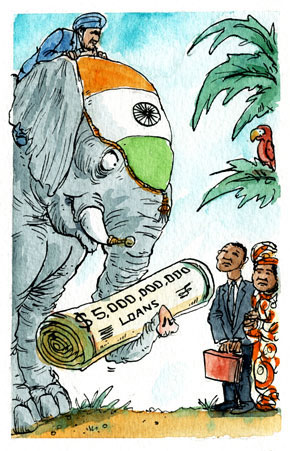
This contrasts with some of news stories that show that India is trying to match China with developmental resource-backed loans. However, the ability to relate to one another culturally will be more important in the long term success of engagement with the continent than how big of a loan you can offer.

Here are some noteworthy India in Africa news stories of late:

The Case for Sanctions in Syria – Lessons from Africa

Sanctions are a hard form of economic power that Joseph Nye discusses in chapter three of his new book, The Future of Power, and a topic that is discussed widely today in relation to Syria. Many policy makers are pondering whether sanctions will be useful in convincing President al-Assad to stop killing his people. No doubt some in the camp that support sanctions would point to the smart sanctions that Rose Gottemoeller discusses in her article, The Evolution of Sanctions. She claims this progress has taken place after the world noted the failure of the blanket use of the measure against the Iraq regime that lead to suffering by the target population as a whole, and the corruption it bred. Gottemoeller suggests that smart sanctions “have been honed through the ‘war on terror’, and sanctions are hitting their targets among corrupt elites more often” (109). Many argue that sanctions are better than doing nothing, and a step below military engagement. This enables countries with public opinions that do not support the sacrifice of blood and treasure to still make their preference known in a forceful way. However, despite the near constant stream of sanctions and their intellectually enhanced offspring in the past decade, where do we see successes? Nye explains where economic power can be seen in the world today, but doesn’t place it fully into a country’s diplomatic toolkit. For example, many of the United States’ links with China are symbiotic and the circular relationship requires both sides to make policy changes in order to move forward. Certainly sanctions, as a piece of the arsenal of power could not solve this problem. Thus sanctions as a mode of influence have a fairly limited scope of use, even the ‘smart’ kind.

Continue reading

“Small Groups Can’t Change History or the Law” – ANC

Today, one of the most incredulous remarks by an ANC spokeswomen sparked my interest to such an extent that I felt the need to share it. The remark was from a story about a ban being placed on Julius Malema’s ‘Shoot the Boer’ liberation song. For anyone who has followed South African politics recently, they have undoubtedly come across stories describing Malema’s use of the song to fire up his supporters, often appealing to them using populist and racist speech. Malema of course defends all of this by saying that he is simply using a song from the time of liberation (despite the fact that he was only 9 years old when Apartheid began to fall), and that he does not intend to spark race based violence. Malema is in deeper trouble these days, with his membership in the ANC under review, yet the ANC still felt the need to contradict this ruling

After Malema used the song at a number of rally’s over the past few years, the group AfriForum, an Afrikaans interest group, brought a suit against his use of the song to Equality Court. The court banned the use of the song yesterday with the judge saying Continue reading

The African Cloud: Predictors for Adoption of Cloud Computing

My most recent paper got some twitter promotion by some of the big names in the ICT world. First, my paper got into @ICT_Works and was published in their ICT4D Daily:

https://twitter.com/#!/ICT_Works/status/71223039618060288

Then later that day, a website that I’ve found to have some amazing content during my ICT and Democracy research, @MobileActive, retweeted my post:

https://twitter.com/#!/mobileactive/status/71244340407713793

Between these two Twitter feeds, there are 10,000 followers. When I saw that they had retweeted my story, I expected a flood (or at least close to 100) hits coming through the link to my most recent paper, The Cloud and Africa – Indicators for Growth of Cloud Computing. Alas, not a single follower (according to WordPress’ statistics) of those twitter feeds clicked on my link to read my paper.

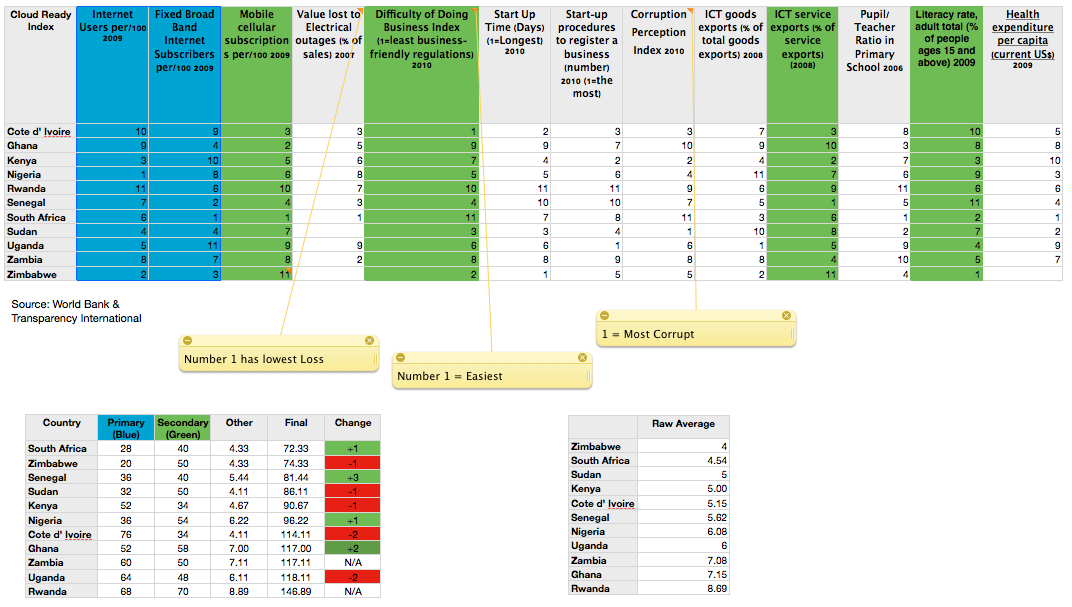
The reason I had been so excited about this paper  was the originality of the idea. I had never written a paper that was so quantitative heavy, but I had to go that route after I found the literature of Cloud Computing to be limited in the development sense. The few mentions of cloud computing in developing markets focused on India and China. So with the limited amount of data, I had to hypothesize and use what I had learned in class to make a prediction. One of the biggest things I’ve learned while being back in academia the past year is the proliferation of the fear of prediction making. So I decided to buck this trend and create a database that would predict which countries in Africa were most likely to embrace cloud computing as a development and economic solution. What resulted was a table that formed the basis for my Cloud Readiness Index. Certainly, it is not anything that would withstand academic review, but something I thought that could be a good conversation starter and one that could provide information to policy makers and businesses on which markets to examine further to determine if they would adopt the model of Cloud Computing.

My class presentation is here.

The table can be seen here.

My paper is linked to here