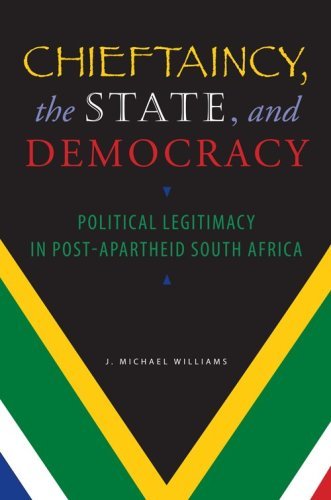
Review of Chieftaincy, the State, and Democracy: Political Legitimacy in Post-Apartheid South Africa


Click Here for: Outline for Book Critique

In J. Michael Williams’ Chieftaincy, the State, and Democracy: Political Legitimacy in Post-Apartheid South Africa, the relationship between the new South Africa’s sources of mixed authority is examined through field research conducted in rural areas in KwaZulu-Natal around the turn of the Millennium. Williams tells of an ongoing struggle in South Africa about political legitimacy between the state and chieftaincy regarding which institution has the right to exert authority in rural areas.

Williams focuses on how the chieftaincy seeks to establish and maintain its political legitimacy with the local population as well as the state in the post-apartheid era. Through comparative case studies he analyzes specifically on how chieftaincy and local populations have negotiated the introduction of specific norms, rules, processes, and institutions that are fundamental to the ANC’s policies of transformation and democratization.Through a framework that Williams calls the multiple legitimacy framework, he seeks to show how the chieftaincy has sought to establish and maintain its authority in the midst of these political changes. With chieftaincy still a central figure in the lives of rural communities in South Africa, the examination of the complexity of the chieftaincy-state and chieftaincy-society relationship that have formed and continue to evolve in the post-apartheid world.

Williams says his analysis is necessary because current assumptions about legitimacy conclude that power will eventually reside in the government as democracy and local government become more ingrained in society. He uses his framework in understanding the results from three case studies in the South African province of KwaZulu-Natal and supplements the data with national economic and survey data from other authors in the field. While stopping short of drawing empirical generalizations, he seeks to use his analysis to tell the story of real South Africans who deal with the struggles of the post-apartheid political structure in their daily lives.
Continue reading

The African File Makes Scholarly Contribution To Zimbabwe

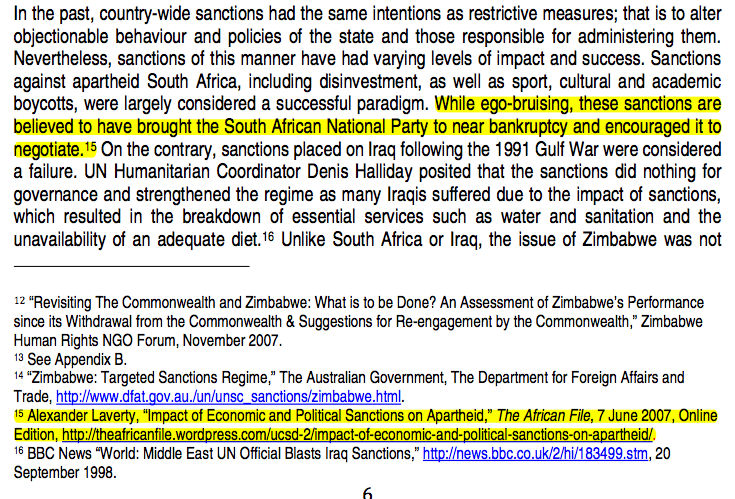
A recent search on the Google search engine has brought an exciting discovery to The African File. In a recent report by IDASA, the Insititute for Democracy in Africa, their work noted The African File’s Impact of Economic and Political Sanctions on Apartheid as a source in the footer. Despite the 4300 hits that article has received in just over two years, this is the first time it has been mentioned in a scholarly/professional article.

The report covers Zimbabwe, and as can be seen below, the article is referenced as the source for:

sanctions are believed to have brought the South African National Party to near bankruptcy and encouraged it to negotiate.

Thankfully, IDASA did not make the case that economic sanctions alone brought the National Party to the bargaining table, and even included a mention for sport, which I made the case for in Sports Diplomacy and Apartheid South Africa.

IDASA Report on Zimbabwe

The full report can be read here and the pdf can be seen here.

The Year of the South African World Cup

This year has been one of fantastic adventures and difficult challenges. Alisa and I began the year in Washington DC having started entry level jobs at the most innovative technology company on the planet, but with no real plan for the future other than to save up and return to Africa, where hopefully we would find employment. When the email came from FIFA on the 5th of February notifiying me that I had won tickets to all the matches I had submitted for during the random drawing, it gave me what I thought would be new purpose to life. I finally had confirmed tickets to return to the country I had fallen in love with only 3 years earlier. It would finally give me a reason to book my plane tickets and set off, hoping that Alisa would tag along for the World Cup part even though she sought to find a ‘real’ job in Washington DC. The year took on new meaning when just seven days later, I received another email accepting me into the African Studies Program at the University of Califorinia – Los Angeles.

I had lost hope of getting into graduate school when I saw my GRE scores flash on the screen the previous December. I thought I had blown my money on apps and the test as well as the chance to improve my chances for ‘real’ employment in the near future. So when UCLA sent the confirmation email of my acceptance, I was relived and surprised that I had got in. That surprise grew when just a few weeks later I learned that the Masters of Public Diplomacy at the University of Southern California had also extended it’s acceptance letter to me. Suddenly I had a reason to return to the United States after the World Cup, and I set out to convince Alisa to embark on this journey of a lifetime. Continue reading

Lost Posts of 2010

Over the course of 2 months in Southern Africa this summer, Alisa and I strove to blog about our experiences everyday to provide friends and family a look into our daily adventures but also as a way for us to document the journey. Hopefully this will allow us to look back in the years to come and get a clearer picture of all that we did and where we went. The blog helped serve as our motivation for keeping track of things we did, as we also felt a responsibility to pass on the insider information we acquired throughout the region so that future travelers would have smoother sailing.

Blogging from the iPad exclusively in Mozambique was difficult as it was our first leg of our adventure, and the least amount of data coverage we would come across. While we sought to review each place we ate and stayed, we quickly realized that our nomadic lifestyle wouldn’t allow for hours of writing each day. Thus days were back logged and reviews were left in drafts. Moving back to South Africa we retrieved Alisa’s Macbook Pro from safe keeping and we were able to write in a speedier manner and catch up to just a day lag for our blog posts. However, we’ve found that days that were written about were not posted, or they were deleted (thanks to the glitchy WordPress app for iPad, which has by now of course recieved many updates making it a much more reliable app). Over this holiday season, Alisa and I were able to pour over our writings together for the first time. We found that our memorable 30 hours in Kimberley never got documented at all, the day before and day of the  France-South Africa match had been lost, and that our days of driving back into South Africa were of such tedium that they were never written down.

While back in the US, the blog will primarily shift back to postings articles on African studies and news, but it will fire back up for the preparation for the next trip back to the African continent!

Below are links to the ‘lost’ posts:

Kimberley Day 1

Kimberley Day 2

Bloemfontein Day 1

Blomfontein Day 2